Books and Films
119 days ago
There are very few instances where I’ve loved a book and then loved the film version just as much. Ian McEwan’s Atonement is one example, Nick Hornby’s High Fidelity another, and of course The Lord of the Rings remains a towering achievement in both formats (one could even say a Two Towering achievement.)
Books and films work in different ways, and there’s a different storytelling syntax for both. What all of the examples I’ve cited above have in common is that the filmmaker has understood and absorbed the vision of the film – what it’s about on a thematic level – and kept that at the centre, while simultaneously exercising their freedom to retell that story in the way that best suits the new medium. I know some people who will react in horror at my including High Fidelity as a shining example, citing the resetting of Hornby’s North-London based novel to Chicago, but for me the central premise of a music-obsessed man taking a reckoning of his love life still rang true. It appears that Hornby himself regards it as a faithful adaptation, commenting that ‘at times it appears to be a film in which John Cusack reads my book.’
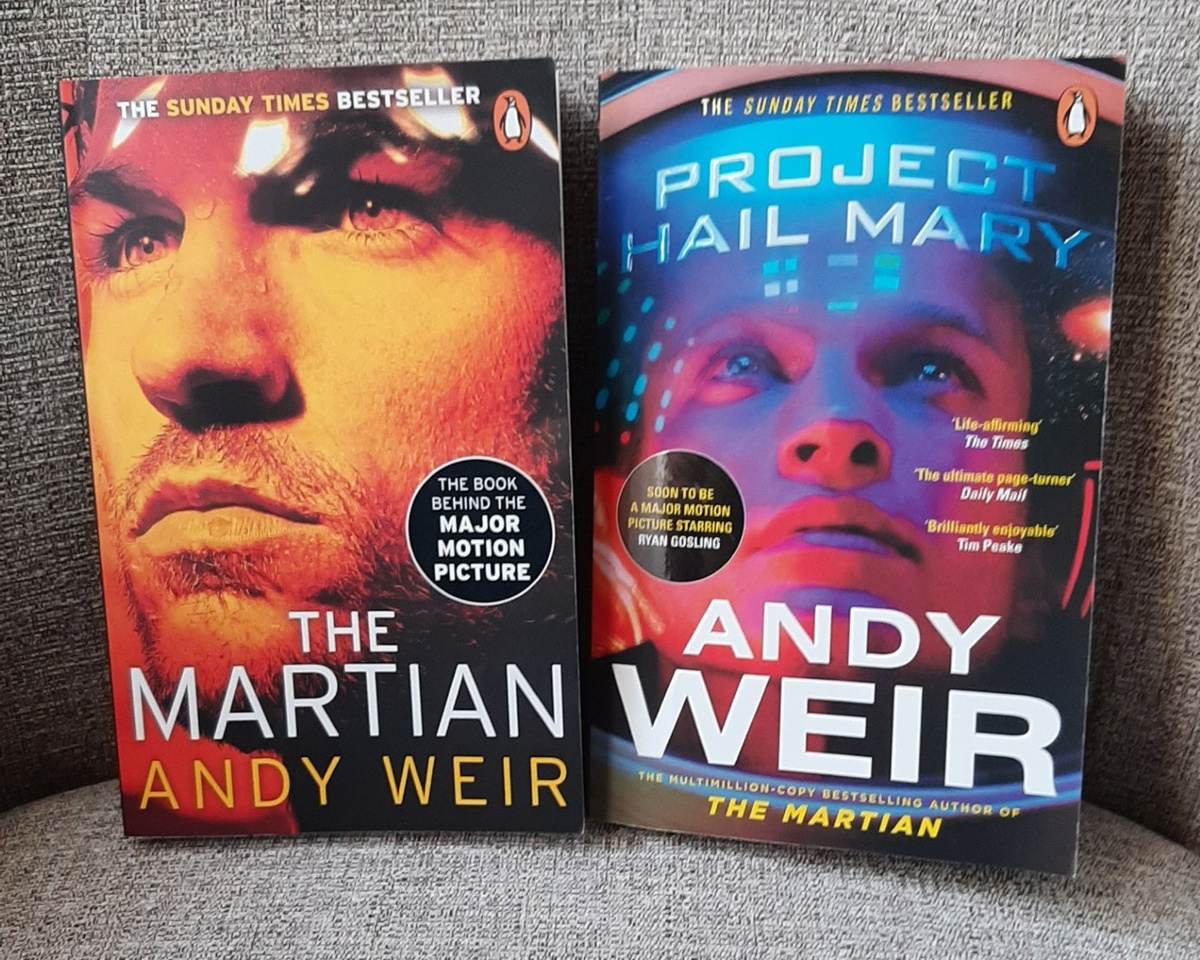
I recently had an opportunity to examine the film vs book debate in detail. I saw the film Project Hail Mary just a couple of days after I finished reading the book. Both are great, but I think I preferred the book. Interestingly, a few weeks later I read another Andy Weir book, The Martian, for the first time, having previously seen and loved the film version starring Matt Damon. Again, I enjoyed both, but this time I preferred the film. Part of me wonders whether my preference is based at least in part on which iteration of the story I first encountered, with the second attempt (from my perspective) facing an impossible task to compete, but I’m not sure that’s all there is too it.
Books have more room to spread out, while films are by their nature more compact. Even with the kind of running times that Peter Jackson allowed himself for The Lord of the Rings, there was much material that needs to be cut or condensed. I found the film version of Project Hail Mary a little rushed in its storytelling after the book (interestingly my wife, who was coming to the story for the first time, felt it a little slow). The opposite wasn’t necessarily true of The Martian – I certainly didn’t find the book dragged in comparison to the brilliant film version – but in that case it’s possible that my prior knowledge of how Mark Watney would resolve his various impossible tasks lessened the impact of the novel.
I have occasionally found myself disagreeing with people about the film version of Captain Corelli’s Mandolin, a cinematic adaptation where the filmmakers seem to have carefully analysed precisely what made the book such a phenomenal piece of work, cut it out and discarded it, then made a film with the leftovers. I have met people who adore the film, but I’ve yet to find someone who holds that view having first read and enjoyed the book.
While I’ve always loved books, that doesn’t mean that I always see the printed version as superior to the celluloid adaptation. Both have to approach the task of storytelling in different ways, and each should be judged on their own merits. If ever anyone makes a screen version of one of my books, I hope that I would do due diligence in only giving the rights to someone who genuinely grasped the underlying vision of the story, then let them get on with telling it in their own way; the novel would remain my thing, the film would become theirs. I remain unconvinced that I would be the right person to adapt my own work, although it’s good advice to never say never in situations like this.
There are no comments yet, be the first to comment...
Your comment will first need to be approved before it is visible.